A corporate office building or IT park in Gurugram is a different maintenance problem from a standalone warehouse or a small commercial block. Multiple tenants, shared base-building systems, high-rise stair pressurisation, large addressable fire alarm networks and a long list of interfaces — lifts, air handling, smoke extract, access control — all have to keep working together, and a facilities team is usually managing several vendors across the building at once. An AMC contract that does not account for that complexity tends to look fine on paper and fail quietly in practice.
What the scope should actually list
Compare AMC quotations on substance, not price alone. The proposals that read shortest are usually the ones that cover the least.
- Visit frequency stated per system — fire alarm, hydrant, sprinkler, extinguishers and any specialist suppression — not a single combined visit for the whole building
- A written task list per visit, mapped against a schedule similar to the one in our inspection schedule guide
- Whether consumables are included — detector cleaning, battery replacement, gland and gasket wear items, extinguisher refills — or billed separately as they come up
- Response time commitment for breakdowns, including whether after-hours and weekend cover is included, which matters in a building occupied outside standard office hours
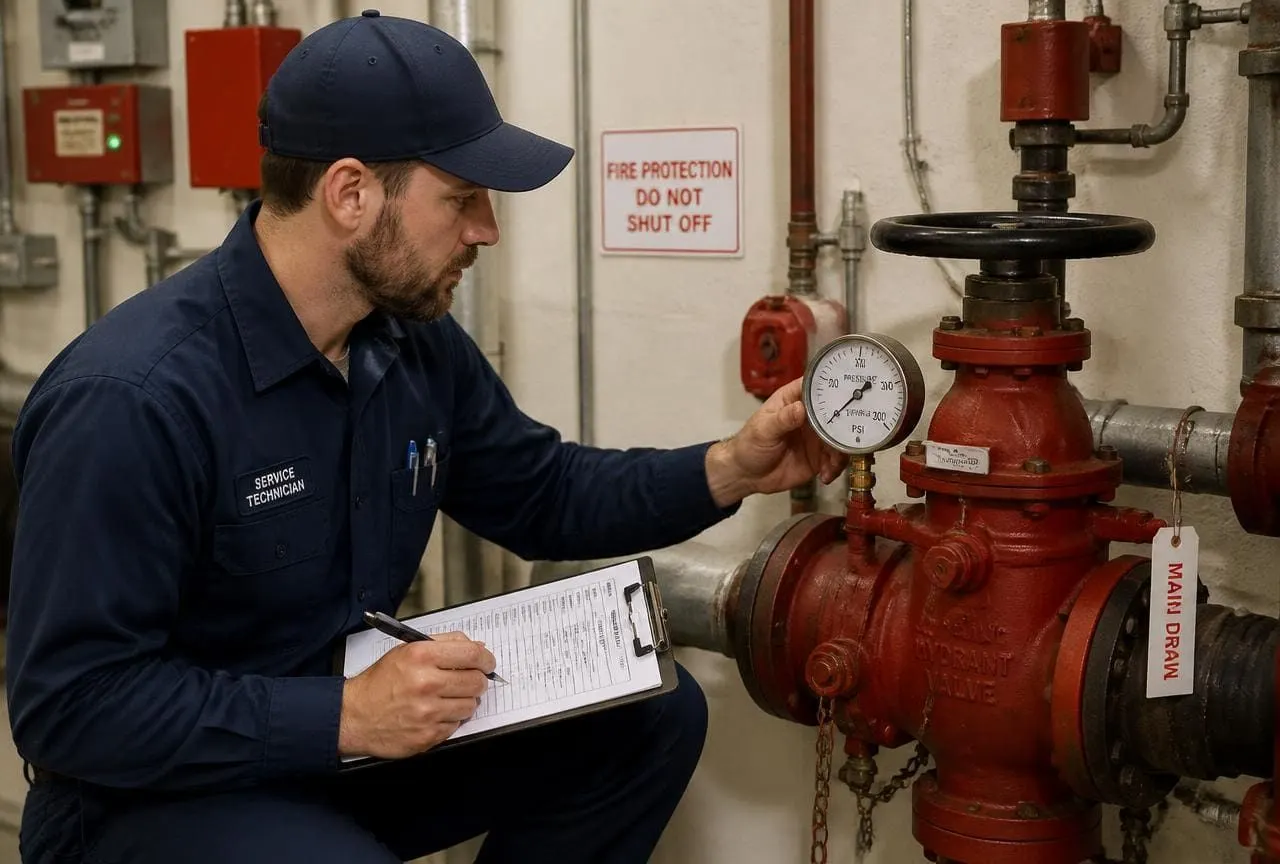
- Whether the contractor produces logged reports with readings — pressures, flows, battery voltages under load — or only attends and signs a visit sheet
- How defects found outside the routine scope are handled — quoted separately, and on what timeline
- Whether an initial condition survey is included before the contract starts, so both sides agree on the baseline being inherited
What is different about a multi-tenant office building
Interfaces have to be tested together, not system by system
In a base-building environment, the fire alarm typically has to trigger a defined sequence — lift homing, stair pressurisation fans, smoke extract dampers, door holder release, and often a public address evacuation message. Testing each system in isolation proves nothing about whether that sequence actually runs end to end. A proper AMC scope should include a periodic cause-and-effect verification across the whole interface list, not just a panel self-test.
Tenant fit-out changes the building constantly
Every tenant fit-out and churn cycle adds partitions, moves detectors out of alignment with the ceiling grid, and sometimes disconnects or bypasses base-building systems without the facilities team knowing. An AMC that includes a documented sweep for unauthorised isolations and detector coverage gaps after fit-out activity catches this before it becomes a live fault during an actual incident.
Stair pressurisation and smoke management need functional testing, not just power-on checks
High-rise office towers commonly rely on pressurisation fans to keep escape stairs smoke-free. A fan that runs is not the same as a fan that achieves the required pressure differential with doors closed — that has to be measured, not assumed, and it should appear as a named line item in the AMC scope rather than being folded into a general 'mechanical systems' visit.
Questions to ask before signing
| Question | Why it matters |
|---|---|
| Is the cause-and-effect matrix tested end to end, and how often? | Confirms interfaces actually work together, not just individually |
| Who coordinates with the building's other vendors (lift, HVAC, electrical) during testing? | Cross-system tests fail without coordinated access and shutdown windows |
| What happens when a tenant's fit-out has isolated a detector or blocked a sprinkler head? | Determines whether unauthorised changes get caught or missed until the next full survey |
| Are stair pressurisation and smoke extract systems measured, not just switched on? | Distinguishes a functional test from a cosmetic one |
| What is the escalation path and response time for an after-hours fault? | Office buildings are often occupied by security and facilities staff outside normal hours |
| Is a condition survey included at contract start? | Establishes what you are inheriting before you are responsible for it |
The short version
A fire safety AMC for a Gurugram corporate building has to manage complexity, not just components — multiple systems, multiple interfaces, multiple tenants and a building that keeps changing after handover. A scope that names every system, tests the interfaces together, and reports with real numbers is the one that actually protects the building. We provide AMC Services for office towers and IT parks across Gurugram and the wider NCR, typically starting with a condition survey so the contract is built on what is actually installed.