Fire protection systems have an unusual failure mode: they can be completely non-functional for years and give no sign of it. A lift that stops working announces itself within an hour. A fire pump that will not start announces itself once, during the only event that matters.
That is the entire argument for a scheduled inspection regime. It is not paperwork — it is the only mechanism that converts an unknown into a known. Below is a practical schedule that covers a typical commercial or industrial building with detection, hydrant, sprinkler and extinguisher scope.
Weekly checks — done by your own team
These are quick, visual and require no specialist. The point is to catch obvious changes fast. Assign them to a named person, not to 'maintenance' in general.
- Fire alarm panel — confirm it shows normal/healthy, with no zones or devices isolated or in fault. Note anything that has been isolated and why.
- Diesel fire pump — start and run it for a short period on the engine's own batteries. Check oil pressure, temperature, battery charge and that it shuts down cleanly. Log it.
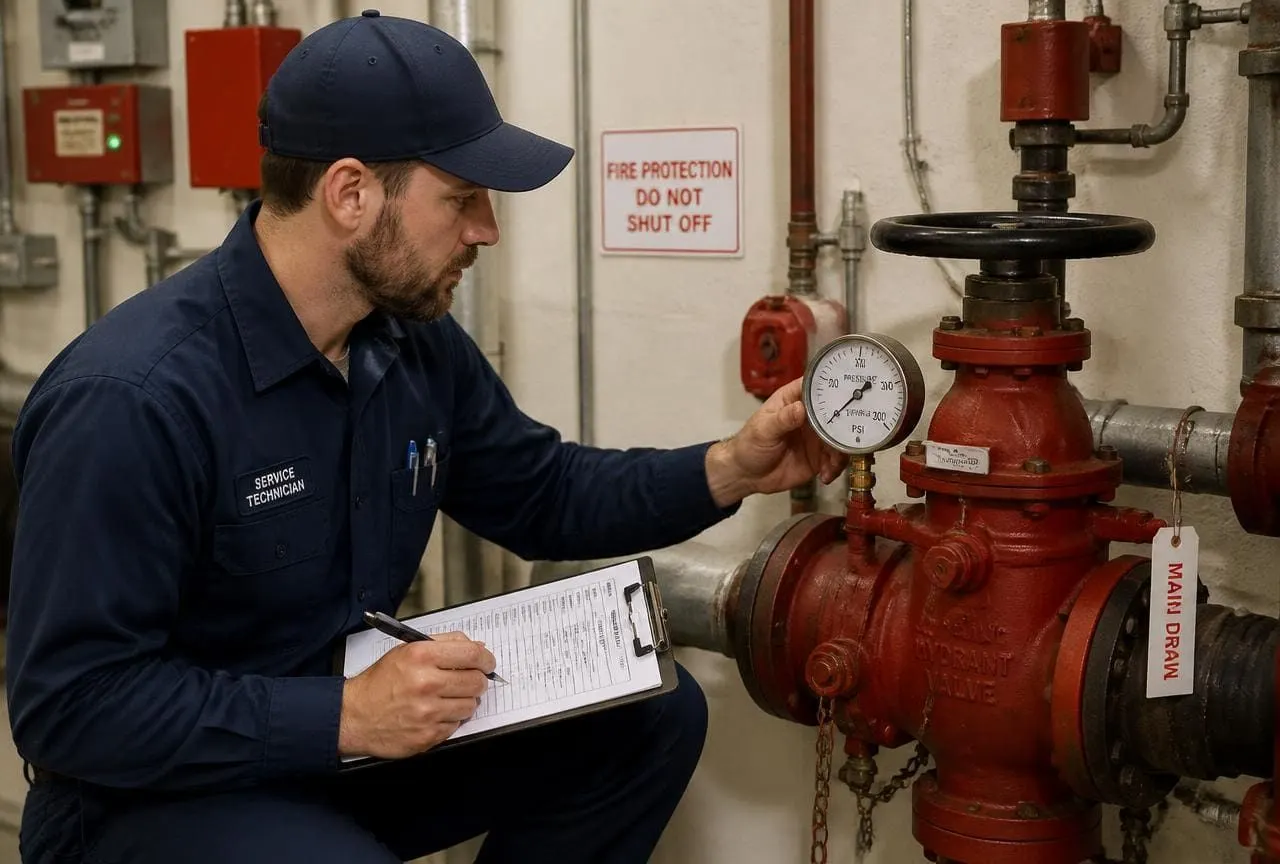
- Pump room gauges — record system pressure and confirm it is at standby value. A drifting reading week to week is early warning of a leak.
- Water tank level — confirm the fire reserve is full and the level indication is working.
- Escape routes and exits — confirm they are unobstructed, exit doors open freely, and nothing is stored in stairwells or in front of hydrant cabinets.
- Extinguisher spot check — confirm units are in place, unobstructed and pressure gauges (where fitted) are in the green.
Monthly checks
- Fire alarm — operate at least one manual call point or detector (rotating around the building month by month) to confirm the panel receives it and the sounders operate. Record which device was tested.
- Automatic pump start sequence — allow system pressure to fall so the jockey, then the main pump, start at their set points. Confirm each starts in the correct order.
- Sounders and strobes — confirm audibility and visibility in all areas, including plant rooms and areas that have been recently partitioned.
- Emergency and exit lighting — a short functional test on battery.
- Isolation valves — walk the network and confirm every valve that should be open is open and secured.
- Hose reels and landing valves — visual check for damage, leaks, missing branch pipes and seized handwheels.
- Extinguishers — a fuller visual inspection: seals intact, pins in place, hoses uncracked, body free of corrosion or dents, service label current, and unit at the correct mounting height and location.
Quarterly checks
- Detector functional testing — a rotating proportion of detectors tested with the appropriate test method (smoke aerosol, heat source or magnet test as applicable), so that every detector in the building is tested within the annual cycle.
- Sprinkler flow switches and alarm valves — operate the test-and-drain connection to confirm the flow switch signals the panel within its time delay.
- Battery health — measured under load, not just a terminal voltage reading, for the panel standby batteries and diesel engine batteries.
- Pump performance snapshot — record flow and pressure at a test line, and compare against the commissioning figures.
- Cause-and-effect spot check — verify a sample of interfaces actually operate: AHU trip, damper closure, lift homing, door holder release.
- Extinguisher weight check — CO2 extinguishers are checked by weight against their stamped tare weight, because a pressure gauge is not fitted.
Half-yearly and annual work
| System | Annual / half-yearly task |
|---|---|
| Fire alarm | Every detector tested and cleaned; full cause-and-effect matrix verified end to end; batteries replaced on age; panel event log reviewed and cleared |
| Hydrant network | Flow and residual pressure test at the most remote and highest outlet; all landing valves operated; hoses run out, inspected and re-rolled |
| Fire pumps | Full performance test against the pump curve; alignment, bearings, glands and couplings checked; diesel engine service per manufacturer schedule |
| Sprinklers | Main drain test; alarm valve internal inspection; sample sprinkler head inspection for corrosion, paint, loading and obstruction; spare head stock and sprinkler spanner confirmed |
| Extinguishers | Full service by a competent agency — discharge test, internal inspection, refill and re-pressurisation on the applicable cycle for each type |
| Water storage | Tank inspection, cleaning and confirmation that the fire reserve draw-off arrangement is intact |
| Passive protection | Fire doors checked for closing, latching and intact seals; visible fire stopping at service penetrations inspected |
| Training | Evacuation drill with timing recorded; refresher training for fire wardens and extinguisher users |
Extinguisher servicing and refilling cycles
Portable extinguishers have their own maintenance cycle, and it varies by type and by the standard the unit is manufactured to. In broad terms there are three levels:
- 1Monthly visual inspection — carried out by the building's own staff. Presence, access, seals, pin, gauge, hose condition, service label.
- 2Annual maintenance by a competent agency — external inspection, weighing, checking the discharge mechanism, and for some types a partial or full internal inspection.
- 3Periodic refilling and hydrostatic pressure testing of the cylinder — carried out on a longer cycle set by the extinguisher type and the applicable standard, and stamped on the cylinder when done.
Do not assume all extinguishers in a building share a cycle. A dry powder unit, a CO2 unit and a mechanical foam unit will typically have different refill and test intervals. The service label on each unit is the record that matters, and it should show the date, the agency, and the next due date. Our Fire Extinguishers and Safety Equipment scope covers supply, servicing and refilling under one schedule so cycles do not drift apart.
Records — the part that gets skipped
An inspection with no record is worth very little. When a fire officer, an insurer or an incoming AMC contractor asks what condition the system is in, the log is the answer. A usable record set includes:
- A dated log book or digital register for weekly and monthly checks, signed by the person who did them
- Service reports for every quarterly and annual visit, listing what was tested, what was found and what was rectified
- Test results with numbers on them — pressures, flows, battery voltages under load, timings — not just tick marks
- A defect register showing what was found, what was done and what is still open
- Extinguisher servicing records with unit-level detail
- Drill records with attendance and evacuation time
- Updated as-built drawings whenever the system is modified
What a good AMC scope looks like
When you compare AMC quotations, they will look similar on price and very different on substance. The things to check are:
- Visit frequency, stated per system — not a single 'quarterly visit' for the whole building
- A written task list per visit, mapped to the schedule above
- Whether consumables are included — detector cleaning, gaskets, glands, batteries, extinguisher refills
- Response time commitment for breakdowns, and whether that includes after-hours attendance
- Whether the contractor logs and reports, or only attends
- What happens to defects outside scope — are they quoted separately, and how quickly
- Whether an initial condition survey is included before the contract starts, so both sides know what they are inheriting
That last point is the one to insist on for a system installed by somebody else. A condition survey establishes the baseline: what is installed, what works, what does not, and what needs rectification before a maintenance contract can meaningfully begin. Starting an AMC without one means paying to maintain faults you did not know you had.