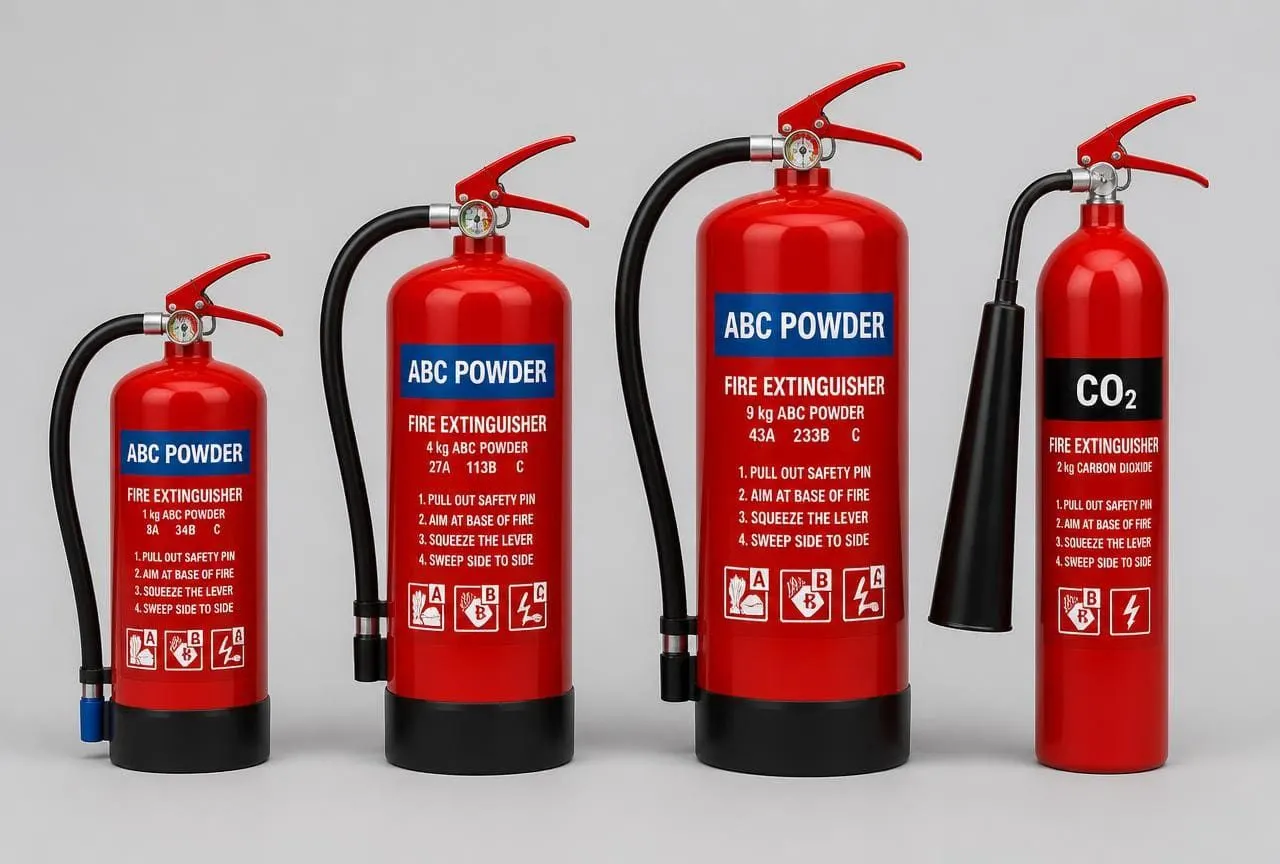
Extinguishers are the cheapest part of a fire protection system and the part most often specified badly. The failure mode is rarely a defective cylinder. It is the right extinguisher in the wrong place, or the wrong extinguisher in the right place — and both are found on almost every building we survey.
Getting it right starts with one idea: extinguishers are classified by what burns, not by where they are hung.
Fire classes — what is actually burning
| Class | Fuel | Typical locations |
|---|---|---|
| A | Ordinary combustibles — wood, paper, cloth, cardboard, most plastics | Offices, storerooms, corridors, warehouses |
| B | Flammable liquids — petrol, diesel, oils, solvents, paints | Generator rooms, workshops, paint stores, fuel handling areas |
| C | Flammable gases — LPG, methane, acetylene | Gas banks, kitchens, laboratories, process plant |
| D | Combustible metals — magnesium, sodium, aluminium swarf | Specific metalworking and process industries only |
| K / F | Cooking oils and fats | Commercial kitchen ranges and deep fryers |
| Electrical | Not a fuel class in itself — live electrical equipment involved in a fire | Panel rooms, server rooms, plant rooms |
Class labelling conventions vary slightly between standards — cooking oil fires are Class K in some systems and Class F in others, and electrical risk is treated as a qualifier rather than a class in most. The practical point is unaffected: match the medium to the fuel.
ABC dry powder — the general-purpose choice
Mono-ammonium phosphate powder, effective on Class A, B and C fires and safe on live electrical equipment. It works by interrupting the chemical chain reaction of combustion and by forming a crust over solid fuel.
Where it works well
- General circulation areas, corridors, staircases and lobbies
- Warehouses and storage areas with mixed contents
- Workshops and industrial floors with both solid and liquid fuels present
- Vehicle parks, loading bays and yard areas
- Anywhere a single unit has to cover an unpredictable mix of risks
Its real drawbacks
- Massive collateral damage. The powder is fine, gets everywhere, and is corrosive to electronics. Discharging one in a server room usually destroys more equipment than the fire would have.
- Severe visibility loss. Indoors, a discharge produces an instant white cloud that can obscure the escape route.
- It cools poorly. Powder knocks flame down quickly but leaves the fuel hot, so a deep-seated Class A fire can reignite.
- Inhalation nuisance in confined spaces.
CO2 — the electrical and clean-area choice
Carbon dioxide discharged as a gas and cold vapour. It displaces oxygen at the fire and cools somewhat, and it leaves no residue at all. That single property — no residue — is why it is the default around electrical and electronic equipment.
Where it works well
- Electrical panel rooms, LT rooms and switchgear
- Server rooms, network rooms and control rooms
- Laboratory equipment and precision machinery
- Anywhere powder residue would cause more loss than the fire
Its limitations
- Poor on Class A. It does not cool a deep-seated solid fuel fire, which will reignite once the gas disperses.
- Asphyxiation risk in small enclosed rooms. In a small unventilated space, discharging CO2 reduces the oxygen concentration for the person using it too.
- Frost burn risk. The horn gets extremely cold in use; the extinguisher must be held by its handle, and the horn should be of the frost-free type where staff are likely to use it.
- Short discharge time and short range. It has to be used close to the fire.
- Heavy for its capacity, because the cylinder is a high-pressure vessel.
- No pressure gauge — CO2 units are checked by weighing against the stamped tare weight, not by reading a gauge.
Foam — the flammable liquid choice
Mechanical or AFFF foam forms a blanket over a liquid surface, sealing vapour in and separating the fuel from air. It also has good cooling on Class A fires because it is water based.
- Best on Class B flammable liquid fires — fuel storage, generator rooms, oil handling, paint and solvent stores
- Also effective on Class A, so it covers mixed solid and liquid risk in one unit
- Not for use on live electrical equipment, because the foam solution conducts
- Not for cooking oil fires — a wet chemical unit is the correct choice there
- Application technique matters: foam should be laid gently onto the burning surface or bounced off a back wall, not fired directly into the liquid, which breaks the blanket and can splash burning fuel
Water and wet chemical
Water extinguishers — plain water, or water with an additive or in a mist form — are the most effective option for deep-seated Class A fires because they cool the fuel rather than just knocking down flame. They are cheap and produce no damaging residue. Their limits are absolute: never on live electrical equipment, never on flammable liquids, never on cooking oil.
Water mist units are a useful middle ground in some settings. The very fine droplet size means far less conductivity and less water damage, and some units are rated for use near electrical equipment — but only within the rating printed on that specific extinguisher, which must be checked rather than assumed.
Wet chemical extinguishers contain a potassium-salt solution designed specifically for cooking oil and fat fires. The agent reacts with the hot oil to form a soapy layer that seals the surface and cools it. In a commercial kitchen it is the only correct portable option for a fryer or range fire, and it should sit alongside a fire blanket and, where fitted, a hood suppression system.
Quick selection table
| Location | Recommended | Avoid |
|---|---|---|
| General office floor | ABC powder, or CO2 near workstations and equipment | Water near electrical points |
| Server / network room | CO2 (clean agent where a fixed system is fitted) | ABC powder |
| LT panel / switchgear room | CO2 | Water, foam |
| Commercial kitchen | Wet chemical, plus a fire blanket | Water, ABC powder on a fryer |
| DG set / fuel store | Foam and ABC powder | Water |
| Warehouse floor | ABC powder, water for bulk Class A stock | CO2 as the primary unit |
| Paint / solvent store | Foam | Water |
| Car park / loading bay | ABC powder | Water alone |
| Laboratory | CO2, with type matched to the specific chemicals present | Generic single-type provision |
Placement, quantity and size
Where extinguishers go and how many you need is governed by the applicable standard for your occupancy and hazard classification, so the numbers should come from that standard rather than from a rule of thumb. The principles behind it are consistent everywhere:
- Extinguishers go on escape routes and near exits, so a person moving towards safety passes one — not deep inside a hazard area.
- Maximum travel distance to the nearest suitable unit is limited, and it is measured as a walking route, not a straight line.
- Units must be visible, or signed with a clearly visible location marker where they are not.
- Mounting height should let any adult lift the unit down safely; heavier units are mounted lower or floor-stood on a stand.
- Access must be permanently clear. Extinguishers behind stacked cartons or parked trolleys are the most frequent audit finding of all.
- Size matters as much as type. A small unit is easier to handle but may not have the capacity for the risk; the standard's rating for the hazard class should decide it.
- In multi-hazard areas, provide the combination the risks require rather than a single compromise unit.
The mistakes that make good equipment useless
- 1Nobody has been trained. An untrained person typically discharges the whole unit into the flame tips instead of the base of the fire, from too far away. Training is the highest-return spend in the whole extinguisher budget.
- 2Extinguishers are blocked. Stock, furniture and trolleys accumulate in front of them within weeks of handover.
- 3The wrong type for the room, most often powder in a server room or a water unit near electrical equipment.
- 4Service dates lapsed, or the unit was never refilled after a small discharge.
- 5Units removed during a fit-out and never put back — check after every refurbishment.
- 6Signage missing, so nobody knows where the nearest unit is under stress.
- 7No decision rule about when to fight and when to leave. Anyone using an extinguisher should have a clear exit behind them, and should evacuate the moment the fire is not going out.
If you are reviewing an existing building, the fastest way to fix extinguisher provision is a room-by-room survey that records the hazard in each space, the unit currently provided, its service status and the travel distance. Our Fire Extinguishers and Safety Equipment scope covers that survey, supply, servicing and refilling — and a short Fire Safety Training session makes the equipment genuinely usable by the people who would reach it first.